MCP transport
P05 implements a local MCP transport over standard input and output. It binds typed shared services without implementing application control, rendering, or simulation backends. The user guide describes workspace and native session configuration with their tool outcomes.
The runtime uses mcp>=1.28,<2, pillow>=12,<13, and the existing Pydantic requirement.
The lockfile records tested versions.
The official SDK v1 source defines the supported protocol interfaces.
Ownership and contract agreement
P05 owns src/resinsight_mcp/mcp/ and its transport tests.
P04 owns the application session implementation.
The P04 owner reviewed the SessionService contract before P05 bound its operations.
That contract extends the existing ProcessController without changing its signatures.
The agreed optional resinsight extra contains rips and psutil for P04.
An extra selects optional runtime dependencies.
P04 provides that extra independently of the MCP runtime dependencies.
The workspace configuration does not import the optional ResInsight runtime.
The launcher imports it only when the user requests native session configuration.
Model tools use the reviewed P07 and P08 services through optional bindings.
The OPM workflow binds the reviewed well, schedule, Flow, result, and view services through their explicit configuration.
Public entry points
Bindings holds one required WorkspaceStore and optional session, rendering, model, well, schedule, job, Flow, and result implementations.
These implementations retain ownership of engineering state.
create_server(bindings) creates an SDK Server with no application lifecycle changes.
serve_stdio(bindings) serves one dedicated process using the SDK stdio transport.
WorkspaceManager can wrap these bindings for one connection that selects among several local workspaces.
import asyncio
from pathlib import Path

from resinsight_mcp.mcp import Bindings, serve_stdio
from resinsight_mcp.workspaces import SqliteWorkspaceStore

store = SqliteWorkspaceStore.open(Path("/absolute/path/workspace"))
asyncio.run(serve_stdio(Bindings(workspaces=store)))
To bind application operations, supply sessions=service with a SessionService implementation.
The session implementation guide describes the provided ResInsight service and native factory.
To bind fresh images, supply renderer=renderer with a Renderer implementation.
The caller must supply services that share the same workspace store.
This injection point does not establish external application behavior.
Shipped launcher configuration
LauncherConfiguration owns workspace, model, native session, and OPM workflow composition.
The command accepts either --workspace-root or --workspaces-root.
The fixed mode also accepts --create-workspace.
Both modes accept --enable-models, --resinsight-log-directory, --enable-opm-workflow, and --docker-executable.
In fixed mode, the native option validates the log directory, imports the optional factory, and checks lsof before opening workspace storage.
Configuration failures return exit status 2 with a standard error message.
Managed mode creates a parent directory and exposes workspace_create, workspace_list, workspace_select, and workspace_current.
It starts without a selected workspace and routes all other advertised tools through the selected workspace.
It caches one runtime per selected workspace within the process.
The selection is connection-local and is not persisted.
Managed mode rejects symbolic-link workspace roots and symbolic-link child workspaces.
Each child directory must be a compatible workspace before it appears in workspace_list.
Optional dependency checks run when the runtime for a selected workspace is created.
The native configuration constructs ResInsightSessionService and RipsApplicationFactory with the same workspace store.
It reuses the factory's timeouts and validation without opening an application during startup.
Executable validation belongs to application_launch, while endpoint, version, and process validation belong to connection operations.
These request values are not launcher configuration fields.
The lead integration owner owns launcher.py, the command entry point, and catalog wiring under issue #35.
P04 retains native session behavior and process ownership.
The model option checks required OPM imports in an isolated process before opening workspace storage.
It supplies OpmImportService and SyntheticModelService with that workspace store.
P07 owns parser validation, while P08 owns constrained model creation.
The transport only binds their typed requests and outcomes.
The launcher evidence records real native acceptance through the installed command.
The OPM option requires native logs and includes the model configuration.
_workflow.check_dependencies() verifies the required generated RIPS interfaces and delegates local Docker validation to FlowConfiguration.
All checks finish before workspace creation or opening.
They do not launch a native application or container.
An explicit Docker executable requires the full workflow and an absolute path.
_workflow.workflow_bindings() composes concrete services against the same canonical workspace root and session coordinator.
Prepared native inputs use persistent native-models paths, and accepted result bundles use persistent native-results paths.
The Flow service supplies both job control and the result output verifier.
The view service supplies view edits and rendering after verified result binding.
The transport does not duplicate parser, completion, simulation, or numerical validation rules.
Prepared-case recovery uses PreparedCaseLookupRequest to locate and verify one case through its immutable source receipt.
This request includes the current project context instead of requiring a native address or an ambiguous case name.
One operation catalog
catalog.py owns tool names, descriptions, request types, result types, session lookup, and annotations.
It also owns the resinsight://catalog resource name.
Tool discovery and the catalog resource derive their schemas from those same records.
The catalog uses the shared request classes for application lifecycle and project operations.
The required workspace binding exposes session creation, listing, lookup, and saved observations.
A session service adds selection, connection inspection, application lifecycle, project operations, and object resolution.
A renderer adds view_render with an explicit session, view context, and requested image dimensions.
The optional import and synthetic bindings add the seven public model operations.
_model_operations.py owns their catalog entries without duplicating input validation or publication rules.
_workflow_operations.py binds prepared cases, modeled wells, schedule publication, result collection, queries, comparisons, and native summary plots.
Job submission retains the existing typed JobRequest, with prepared inputs and bounded limits.
It accepts no command, shell, Python, image selection, or backend substitution argument.
Operations appear only when their implementation was explicitly supplied.
view_list accepts a current LoadedResult and returns typed ResultViewState records without image content.
The service verifies actual native view ownership and returns observed cameras, display scales, and scene versions.
The public operation cannot establish a trusted result binding or adopt a confirmed renderable scene.
view_render resolves the stored result before constructing the shared RenderRequest.
It rejects a context from another session or a report absent from that result.
The returned observation must match the requested context and dimensions.
The renderer remains responsible for fresh output and actual application context.
The transport does not claim that a visual edit changes simulator inputs.
The catalog has no shell, arbitrary Python, transport-selected session, or attached-process authorization tool.
application_close uses the shared detach default.
It cannot set the trusted attached_termination_authorized argument.
The session service retains responsibility for verified process ownership.
Validation and stable failures
The SDK supplies parsing, initialization, discovery, dispatch, and transport behavior. The server validates request JSON through Pydantic before calling a service. JSON validation preserves shared enum, path, and tuple representations without relaxing strict Python construction. Unknown fields and invalid identifier shapes fail before the service call.
The server disables the SDK's generic input-error conversion to preserve the shared error envelope.
It validates service results against each operation's declared response type.
Known ContractError records retain their code, message, and effect.
Unexpected service-call exceptions produce sanitized execution_failed responses and detailed stderr logs.
Unexpected image read or decode exceptions produce render_failed without exposing exception details.
Invalid requests use the existing invalid_model code.
An unavailable tool uses unsupported_operation.
An unavailable resource uses MCP invalid parameters with a not_found error record in its data.
Unexpected failures use effect unknown for mutations and not_applied for read operations.
Protocol and engineering lifetimes
Each fixed-mode server owns protocol handlers and its immutable operation bindings. It has no selected session, workspace cache, application ownership table, or recovery loop. Each managed-mode server also owns one workspace selection and a cache of concrete bindings by workspace. The server serializes a managed operation while it resolves and calls the selected services. Synchronous service calls run in AnyIO worker threads. Service implementations must serialize application mutations as their shared contracts require.
Closing a protocol connection does not call close, detach, cancel, or reconcile. A new stdio process opens the same workspace without changing persisted job states. Application continuity across processes depends on the session service lifecycle and explicit reconnection policy. The maintained P05 fixture tests do not prove real ResInsight process survival. The separate P04 acceptance trial records two real applications that remained running after the SDK client and server exited.
The stdio runner reserves a separate output stream for the SDK.
It redirects ordinary process stdout to stderr before the launcher imports optional native libraries or constructs services.
The public serve_stdio(bindings) entry point keeps the same isolation while serving supplied bindings.
This includes Python output, native library output, and inherited child-process output.
The runner restores stdout when it exits.
Use this runner only in a dedicated stdio process because descriptor redirection affects the whole process.
Native image responses
content.py preserves typed JSON in TextContent and structuredContent.
Successful observations append ImageContent with image/png and no visibility restriction.
Pillow decodes the stored image and checks its format and declared dimensions.
An empty, corrupt, mislabeled, missing, or mismatched image produces an explicit failure.
A successful EditedView or EditedSummaryPlot preserves its applied edit receipt when image delivery fails.
The nested observation records the failure, and the outer operation remains successful.
No prior image replaces a failed observation.
The transport does not infer that a saved image represents the current application state.
Summary observations retain the exact curve, result, plot address, source summary artifact, and current application context.
Maintained evidence
tests/mcp/ uses real SDK clients and public workspace APIs.
Stdio tests launch independent Python server processes.
They exercise typed discovery, session isolation, reconnects, stable failures, native images, and stderr separation.
Image tests use supported Pillow decoding without byte or pixel comparisons.
Session binding tests use an explicit test service through the SDK in-memory transport. They establish transport routing and lifecycle separation, not real application control. The P05 evidence record records reviewed commands, versions, and image acceptance results. Launcher tests start the shipped module through real SDK clients and exercise configured discovery, dependency failures, and output isolation. Their native protocol fixture covers launch, project changes, stale references, disconnect, and explicit attachment after restart. Model launcher tests exercise real parser validation and public import, creation, inspection, cloning, preparation, and retrieval after reconnection. They also verify unavailable dependencies before workspace creation and clear failures for unsupported inputs or backends. The separate launcher record proves the corresponding real application path from a noneditable installation.
Model launcher evidence
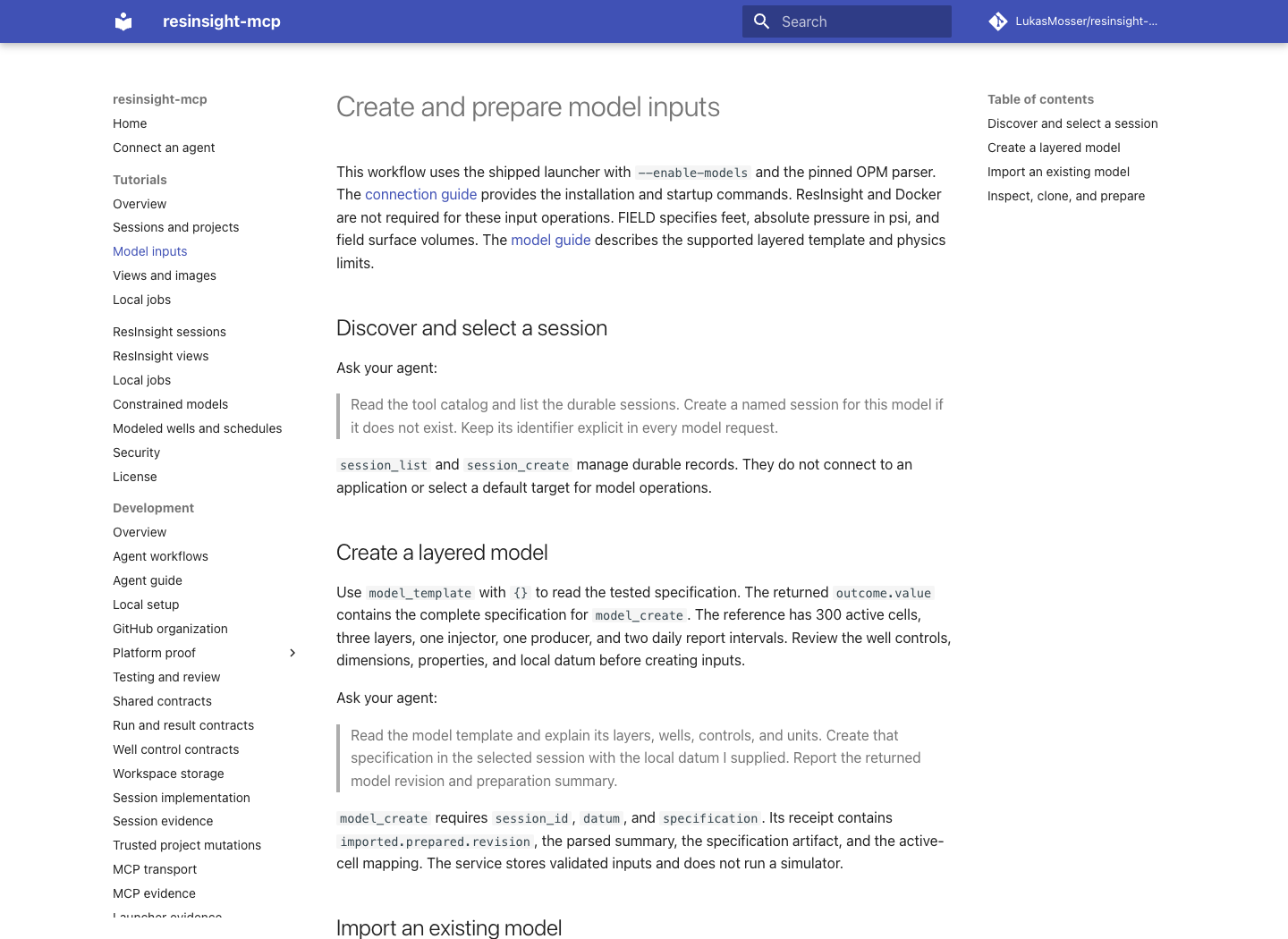
The model configuration passed five focused public MCP tests and 532 shared repository tests. The model log, shared check log, and environment record preserve that evidence. The tests create and clone a model, disconnect, reopen its workspace, inspect inputs, and prepare the exact child revision. They also exercise imported inputs, invalid units, absent sessions, unavailable dependencies, disabled tools, and unsupported backends. The browser record and model tutorial image support the guide review. The following workflow integration extends that model slice within issue #35.
Workflow launcher evidence
The new launcher tests use the shipped module, real SDK processes, concrete services, and the real supported OPM parser. They verify full discovery, explicit session boundaries, persistent model access, disabled tools, and startup failures before workspace creation. Only external dependency preflight is replaced in the complete composition test. The maintained suite starts no ResInsight application or Flow container for these checks.
Summary content tests create a confirmed plot through the result service's controlled native boundary. They verify exact curve identity and applied receipts when the stored image is missing, has wrong dimensions, or was never produced. Pillow decodes the successful delivered PNG. These tests do not replace the separate native result and complete public workflow acceptance records.