Persistent well lifetime acceptance
Issue 48 supplies the P07 and P09 prerequisite for P13. The acceptance record identifies the command, source commits, Python version, and check counts. The shared repository command and pre-commit hook passed 550 maintained tests, Ruff, ty, and the strict documentation build. The shared log records those checks separately from the native trial.
Native export build
The native patch adds export_prepared_input_grid(path, output_path).
It uses OPM's supported EGRID writer and accepts only the existing FIELD profile.
It does not create native cases or run a simulator.
The first build trial failed because the empty connection vector required the complete NNCdata declaration.
The supported NNC.hpp include fixed that compile error.
The export build command and build log passed at native commit e9baf8b9eaa86ba2d44b9c9f5c1e29faa8321a67.
The reload patch loads each property source once and preserves source order.
It also creates ordinary derived results before property reload, preserving initial property names.
Nested hybrid ordering and existing preferences remain unchanged.
The deduplication build and stable-name build passed.
The accepted native source is 551dc02e19a1eb75ae462a0313f7a9a3101c2f45.
These internal fixes do not change the generated RIPS interface.
Earlier trials
Trial 01 passed its original 42 checks but did not establish stable property inventories.
Review found seven imports of the same source file during reopening.
Deduplication removed that growth, but Trial 02 failed the new exact inventory check.
Derived names changed from DX_1, DY_1, and DZ_1 to DX, DY, and DZ.
The corrected load order passed the unchanged probe in Trial 03.
Both earlier trials retain their original records and successful owned-process cleanup checks.
Installed client and application
The trial used a wheel built from that native bundle's complete generated Python package.
The client installation records its native source and wheel provenance.
The runtime installation records both installed application and RIPS module paths and their direct_url.json metadata.
Both packages used ordinary noneditable wheel installation inside an isolated environment.
No runtime sys.path changes or source checkout imports supplied application behavior.
The dependency installation used the existing lockfile and cached dependencies.
It excluded the published RIPS package before installing the explicit matching wheels.
The native trial used ResInsight 2026.9.0, RIPS 2026.9.0.1, OPM 2025.10, grpcio 1.83.1, and protobuf 7.36.1.
No packages were downloaded for this trial.
Saved-project result
The manual runner tests/resinsight/modeled_wells/lifecycle_probe.py passed all 45 native checks.
The installed application source was a60788d, and the manual probe source was ce76239.
Its launch request created one owned native process.
Invalid parser input, METRIC input, and an existing export destination failed without changing native cases.
Parsed GRIDUNIT contained FEET.
The service exported a persistent EGRID, loaded it with grid_only=True, imported seven property arrays, and created the working view.
It then created PROD and saved the native project.
The runner completed two save and reopen cycles before detaching the original service connection.
The exact seven-property inventory remained unchanged after cycle one and cycle two.
A fresh service and workspace handle restored the current case using its immutable receipt.
Explicit well adoption issued a new connection identity and version zero.
The old reference failed, and the service retrieved the earlier immutable export from workspace storage.
The before readback and after readback retain 300 cell centers, 2,400 corners, active-cell order, and seven property arrays.
Every saved and reopened value matched exactly.
Independent parser comparisons used relative tolerance 1e-6 for native floating-point storage.
Depth comparisons also allowed 0.001 feet absolute tolerance, and property comparisons allowed 1e-8 absolute tolerance.
The receipt ties all corner coordinates to the exact model revision and persistent source path.
The created well and adopted well each contain 170 trajectory samples ending at 8,430 feet.
The earlier completion snapshot and restored snapshot retain the same three connections.
Their zero-based cells are (4, 4, 0), (4, 4, 1), and (4, 4, 2).
Their FIELD factors are 10.078780273272798, 1.5913863589378099, and 10.397057545060358.
Those factors match the earlier P09 reference within relative tolerance 1e-6.
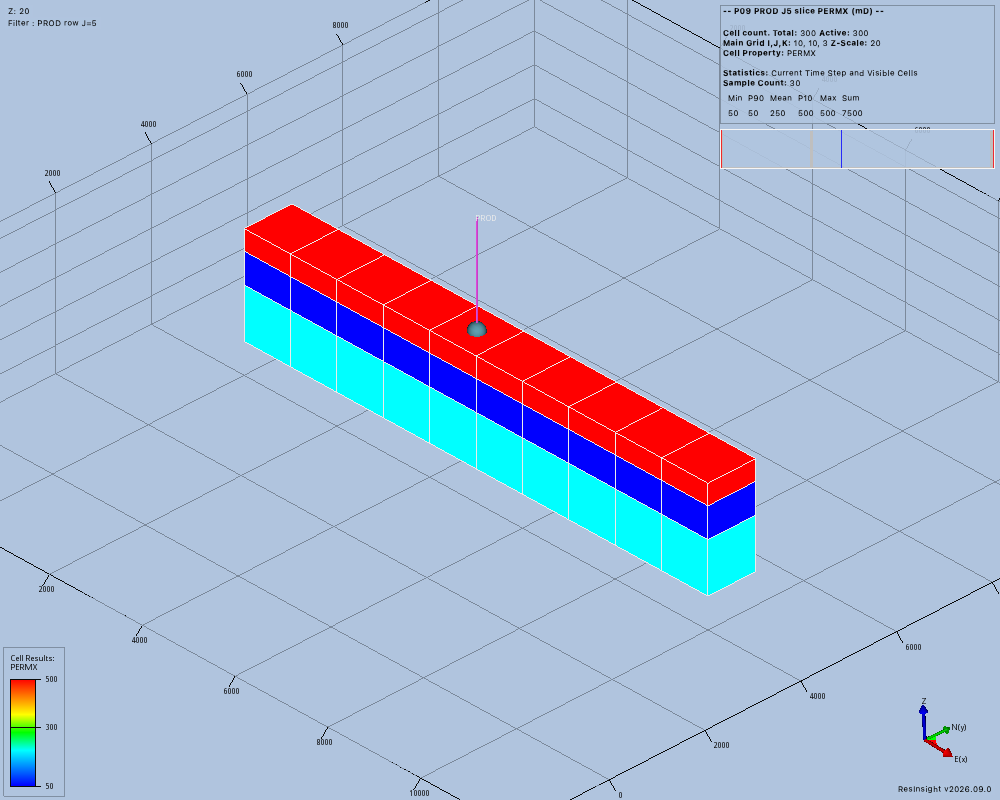
The image shows the restored J=5 PERMX slice, the PROD label, and the 50 to 500 mD legend. The display scale is 20. Opaque cells hide the interior well segment, whose trajectory and cell connections are established by the numeric records.
The owned process record identifies PID 92906 and start marker 1788971155.851697.
The runner verified that identity before termination.
The final check confirmed that the PID was absent.
Persistent model sources remained available after service close.
Scope and limits
The lead integration record identifies the tested source and current tool versions. Its shared check log passes 579 maintained tests, including source-path lookup and ambiguous-case failures. Lead review inspected the complete accepted native checks and restored image before integration. The new lookup uses the same verified restoration boundary, while full public MCP acceptance remains part of P13.
This trial establishes the bounded FIELD grid and well lifetime needed by the P13 launcher. It does not establish full P13 MCP acceptance or simulator execution. P11, P12, and the lead's clean launcher trial retain their separate evidence requirements. The approved localhost browser review passed six rendered views and 102 local links. The lead inspected all six guide screenshots, including the embedded native result. The strict documentation build passed, and the native screenshot was also inspected directly.